How do you use ChatGPT for a cover letter without it sounding like ChatGPT?
Give it the whole posting, your real resume and three achievements with numbers. Then rewrite the draft. The prompt is the easy part; the edit is the work.

Give it three things: the whole posting, your actual resume, and three achievements with numbers. Then rewrite the draft in your own words and check every proper noun by hand. A model will invent employment you never had, and it will not catch the wrong company name.
- A prompt containing only a role title and a company name produces a letter about nobody. Paste the full posting and the full resume.
- Put the constraints in the prompt: 250–350 words, no "I am writing to apply", one specific ask at the close.
- Iterate on the draft rather than accepting the first one — shorter, more specific, stronger verbs.
- Any sentence that could appear in someone else's letter gets replaced with one only you could write.
- Company name, role title and recipient name are verified against the posting, not against the draft.
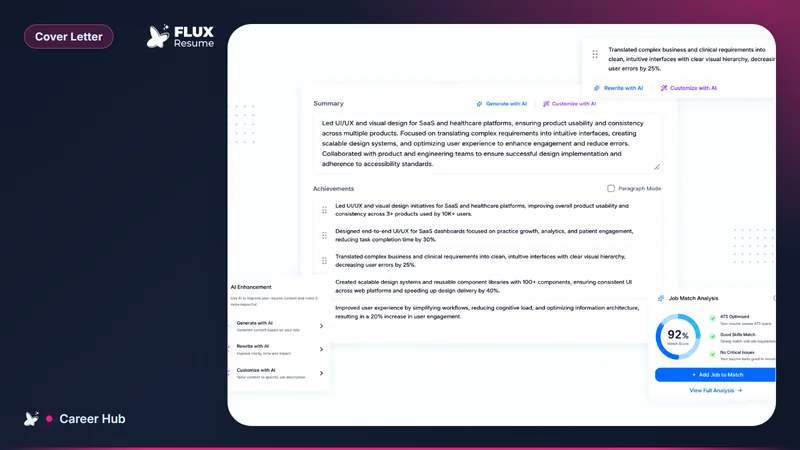
- FluxResume's Cover Letter Smart Mode drafts from a job plus a resume already in your account, and Humanize runs after a draft exists to soften tone — it does not change what the draft was built from.
What does the model need from you?
Five inputs, and the letter is roughly as good as the weakest one.
- The complete posting, not a summary of it. The requirement wording is what the letter has to answer.
- Your full resume. An abbreviated version produces vague paragraphs, because the model has nothing specific to reach for.
- Company research you gathered yourself — the mission statement, the recent announcement, the current product line.
- Three to five achievements with numbers, written out. These are the sentences that make the letter yours, and they cannot be generated.
- Two or three sentences of your own career story, in your own words, for tone.
The third input is where the shortcut costs you. Asking an assistant to "research the company and write a letter" returns confident, specific-sounding detail about initiatives and values, some of which may not be true of that company at all, and a letter praising a strategy they never announced is worse than one praising nothing. Read their own pages, then paste what you read.
What does a working prompt look like?
A prompt is a brief, and the constraints matter as much as the content: given no length limit and no banned openings, an assistant will happily hand back a page and a half starting with "I am writing to apply".
I'm applying for [Job Title] at [Company].

Job description:
[paste the entire posting]

My resume:
[paste the full resume]

What I know about the company, from their own site and recent news:
[paste what you actually read]

My relevant achievements:
[3–5 lines, each with a number]

Write a cover letter that:
- opens with an achievement or a specific observation, never "I am writing to apply"
- uses two of my achievements above, each tied to a named requirement from the posting
- is 250–350 words across three or four paragraphs
- closes with one concrete next step
- uses plain language, no buzzwords, no "passionate about"
Then iterate: "cut it to 300 words", "replace the second paragraph with the achievement about the migration", "use stronger verbs and delete every adverb", "remove any sentence that could apply to a different company", "make the close a single specific ask". Each is a smaller, checkable instruction than "make it better", which is why they work.
What has to be rewritten, and what can stay?
There is no percentage that makes this safe; treating it as a quota is the wrong test. The test is per sentence, in two parts: every factual sentence is one you can defend in an interview, and every voiced sentence sounds like you.
Rewrite by default:
- The hook. Drafts converge on a small set of openings, so this is the sentence most likely to read as generated.
- Any sentence containing a fact about your employment, a tool you used, a team size, or a number. Check each against the resume rather than trusting it.
- Every adjective about yourself. "Highly motivated", "detail-oriented" and "results-driven" are the ones to look for.
- Anything that would still make sense after a find-and-replace of the company name.
Usually fine to keep: paragraph order, the mapping of achievement to requirement, transitions, and the shape of the close. That scaffolding is what a model is genuinely good at, and it is the part described in the six parts of a cover letter. The practical test is reading the result aloud — sentences you would never say out loud are the ones to rewrite, and your ear finds them faster than a reread.
Which prompts help for a career change, an internal move, or an employment gap?
These three scenarios need the letter to do something the resume cannot, which is when a drafting assistant earns its place.
Career change:
I'm moving from [current role] to [target role]. Write a cover letter that
explains the change without criticising my current employer, translates my
transferable skills into the posting's own words, and answers the obvious
objection: why me instead of someone with direct experience.
Shape: a problem I solved in the old role → how that applies here → why the change.
Internal promotion:
I'm applying for [role] at my current employer. Write a cover letter that names
specific projects I've delivered here, shows where I'm already doing parts of
this role, and references a challenge the team is facing. Tone: confident,
not entitled.
Employment gap:
I have a [length] gap in my employment. Write a cover letter that addresses it
in one factual sentence without apologising, notes what I kept current during
that period, and spends the rest of the letter on the work before and after it.
Two smaller prompts work for any letter. "Write three different opening paragraphs and vary the approach" gives you something to choose between instead of something to accept. "Here is what I read about this company — write the paragraph connecting it to my second achievement" keeps the company-specific sentence anchored to something real.
What must you check by hand before sending?
Six things, in one pass, after you have stopped editing prose:
- The company name, everywhere it appears.
- The role title, spelled as the posting spells it.
- The recipient's name, copied from the source rather than typed from memory.
- Every number, against your resume.
- Every claim about where you worked and what you used. This is the failure specific to AI drafting: a model filling a gap in the brief produces a plausible employer, a plausible tool, or a mutual connection you do not have, and it reads perfectly.
- Length, and the attachment itself.
The mistakes worth knowing in more detail — including the ones that have nothing to do with AI — are in the cover letter mistakes post.
Where does FluxResume fit, and what will it not do?
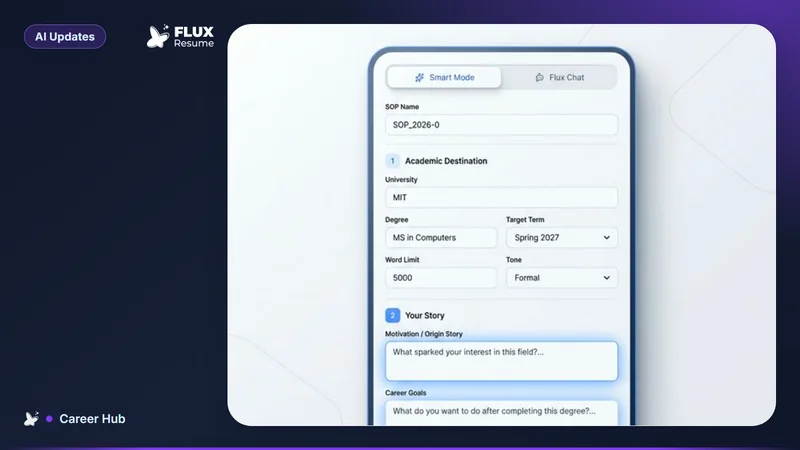
FluxResume drafts letters inside the product rather than in a chat window. Letters live on the Cover Letters tab of the Documents hub, and the tab appears only when Cover Letter is on for your plan. In the Cover Letter editor, the Smart Mode panel takes the job, the resume the draft draws from, an optional recipient, and a tone — Confident, Balanced, Creative, Formal or Passionate. Regenerate rewrites from those settings, Save, Preview and Download are in the header, and letters attached to a job show the company and role on the card. AI Chat is the other place to run a critique pass, since it holds a job and resume as context. The advantage over a chat window is that the inputs are structured, so the most common failure — a draft built from the wrong resume — is visible instead of buried in a scrolled-back message.
What it will not do is decide anything for you. Humanize softens AI tone after a draft exists; it does not change the job, the resume or the tone the draft came from, so a letter that is wrong because the wrong resume was attached needs a different resume and a Regenerate, not a Humanize. Nothing verifies that a claim in the letter is true, nothing flags an invented employer, and there is no library of scenario templates — the prompts above are yours to keep, not something the product ships. Marketing page for the templates themselves: https://fluxresume.io/cover-letter-templates/.
Common questions
Can a recruiter tell a letter was AI-drafted?
Sometimes, and there is no reliable public data on how often, so treat any specific figure you see as unverified. The tell is controllable: generated letters converge on the same openings, the same abstract enthusiasm, and adjectives instead of outcomes. A letter carrying a project only you worked on and a number you can defend does not read as generated, whatever produced the first draft.
How long should the finished letter be?
250–350 words across three or four paragraphs, on one page. A draft will usually overshoot that unless the range is in the prompt, so state it and check the result afterwards. The FluxResume editor keeps word and sentence counts under the page, which is faster than pasting into a counter. If the draft runs long, cut the paragraph that restates the resume — usually the third one.
Should you mention that you used AI?
No, and there is nothing to disclose. The letter is a claim about your experience and your interest in a role, and both have to be true whoever typed the first draft. What matters is that every sentence is accurate and the voice is yours. If a letter needs a disclaimer to be honest, the problem is its content rather than the tool.
Is an AI-drafted letter better than no letter?
Only if you edit it. An unedited draft is a generic letter with extra steps, and a generic letter is worse than none where the application did not ask for one. The position that holds across cases: send a letter whenever the application gives you a field for it, skip it when there is no field or the posting says resume only, and make sure one sentence could not have been written about any other company.
Originally published March 2025. Reviewed and rewritten for FluxResume in August 2026.
On this page
- What does the model need from you?
- What does a working prompt look like?
- What has to be rewritten, and what can stay?
- Which prompts help for a career change, an internal move, or an employment gap?
- What must you check by hand before sending?
- Where does FluxResume fit, and what will it not do?
- Common questions