How many skills should you list on a resume?
Eight to twelve, chosen from the posting in front of you. Hard skills belong in the list; soft skills belong inside a bullet with evidence attached.

Eight to twelve, and a different eight to twelve for each posting. Hard skills — tools, languages, platforms, certifications — go in the list. Soft skills go inside an experience bullet where evidence sits next to them. Do not send the forty-item master list, and do not claim a level you could not defend in a technical interview.
Eight to twelve is our recommendation, not a finding. No study sets that number, and anyone quoting research for it is quoting nothing. It is where the section stays scannable, stays credible, and still covers what a posting actually asks for.
- Eight to twelve entries per application, chosen from the posting rather than from a template for your industry.
- Keep a longer private list — thirty or more — and cut it down each time. Never send the long one.
- Hard skills go in the list. Soft skills go in a bullet with an outcome attached.
- Drop anything assumed at your level, and anything you last used five years ago.
- Group into three or four labelled categories once you pass ten entries.
- Only claim a proficiency level you would be comfortable being tested on in the first screen.
What is the right number?
A skills section is not an inventory of everything you can do. It is a short answer to a question the reader already has: does this person have the specific things the posting named? Forty entries do not answer it better — they bury the six that matter among thirty-four that do not, and they make every entry less credible, because nobody is genuinely current in forty tools.
Senior applicants often want to push higher, and there is advice saying ten to fifteen past seven years. We would still cap near twelve and use grouping instead: a categorised twelve reads as breadth, an ungrouped fifteen reads as a keyword dump. If twelve will not cover your range, the extra material belongs in the experience bullets, where it arrives with context. Early career, eight is fine — padding a short list with "Microsoft Office" and "communication" is the one thing that makes it look shorter than it is.
Which skills belong in the list, and which do not?
In: tools, programming languages, frameworks, platforms, databases, analytics products, CRMs, design software, certifications and named methodologies. Anything a reader could verify by asking you to do it or by looking up the credential. Out, in four categories:
Assumed skills. Email, internet research, Microsoft Office, basic computer literacy — unless the posting asks for something specific. "Advanced Excel" with pivot tables and modelling is a real skill and belongs in the list if the listing names it.
Stale skills. Anything untouched for about five years, or anything the industry has moved past. A tool that no longer ships is a date stamp, not a qualification.
Skills you touched once. A weekend tutorial is not a resume line.
Skills the posting does not care about. Your Photoshop competence is real and does not belong on a data engineering application. Keep it in the private list.
Do soft skills belong in a skills section?
No — and this is the part worth being firm about.
Communication, leadership, teamwork, problem-solving, attention to detail. Every applicant claims all five, none can be verified from a list, and none tells a reader anything they did not already assume you would claim. Six lines spent on soft skills are six lines not spent on the tools the posting named.
They matter enormously. They are just evidence claims, and evidence lives in bullets:
- Instead of "Strong leadership skills": "Led a cross-functional team of 12 across engineering, design and marketing to ship the billing rewrite two weeks early."
- Instead of "Excellent communication": "Presented quarterly results to the executive team and ran the customer advisory board."
- Instead of "Problem solver": "Diagnosed a recurring checkout failure support had escalated for six months and cut related tickets by 80%."
Each is a soft skill demonstrated rather than asserted, and each gives an interviewer a specific thing to ask about — which is what you want, because you can answer it.
Two narrow exceptions. Where a posting names a soft capability as an explicit requirement — "stakeholder management," "client-facing presentation" — mirroring that exact phrase once is reasonable, because you are matching the listing's own vocabulary. And credentialed interpersonal skills, like a language at a stated level or a mediation qualification, are hard skills wearing soft clothing; list those.
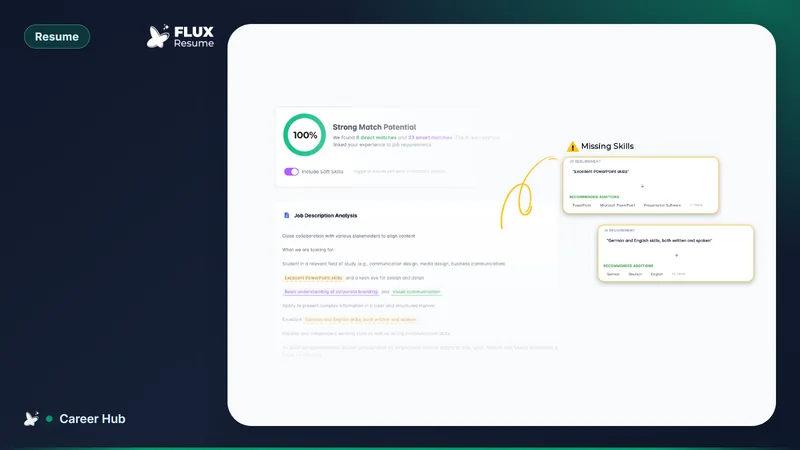
FluxResume takes the same position by default. In the Job Based Resume match analysis, the Include Soft Skills toggle decides whether soft skills count toward the score, and it is off by default. Turn it on when a posting is genuinely built around them.
Should you group skills into categories?
Past about ten entries, yes. Under ten, a single line reads faster.
Three or four labelled groups, four or five entries each:
- Languages: Python, JavaScript, SQL, Go
- Frameworks: React, Node.js, Django
- Platforms: AWS, Docker, Kubernetes
- Methods: Agile, CI/CD, test-driven development
Use the labels your field uses — a marketing version might read Analytics, Advertising, CRM, Content. Grouping buys you a reader who finds the category they care about in one glance instead of scanning eighteen comma-separated items.
Proficiency levels — Expert, Advanced, Intermediate — are mostly not worth adding. They invite a question you then answer under pressure, and "Expert" should mean you are the person others escalate to. Use them only where your field expects them: language proficiency, some regulated professions, occasionally clearances and certifications.
How do you choose which twelve for this posting?
Take the terms from the posting, in this order.
- Must-haves, usually under Requirements or Qualifications. Every one you genuinely have goes in.
- Repeated terms. Anything named three or four times is what the role does day to day.
- Named tools. Products, platforms, versions — the highest-value entries, because they are unambiguous.
- Nice-to-haves you have. Fill remaining slots from the Preferred or Bonus section.
Use their exact wording: "JavaScript" not "JS," "Project Management" not "PM." Where an acronym is standard in your field, give the spelled-out form and the acronym once between them. Placement rules and the point where mirroring becomes stuffing are in how to add keywords to a resume without stuffing it, with a longer version at fluxresume.io/guides/ats-resume-keyword-strategy/.
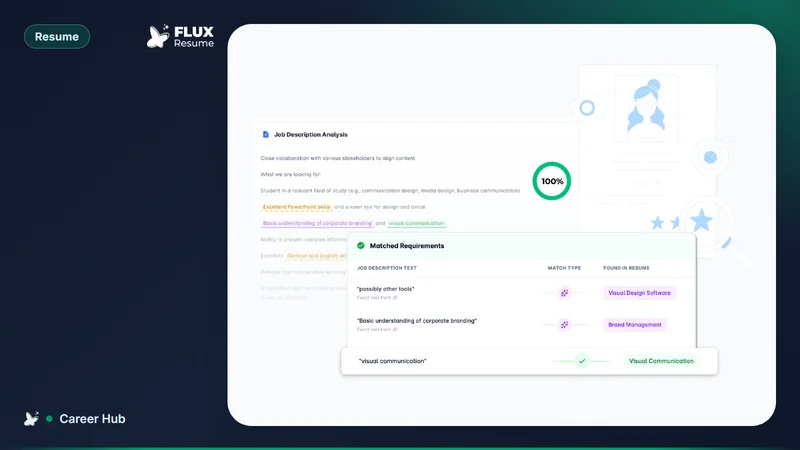
Skills is one of the Documents sections with an AI assistant, so you can re-cut the list there and build the rest of the resume around it at fluxresume.io/resume-builder/. With a job attached, the match analysis separates the posting's requirements into the ones your text already matches and the ones missing from it. Treat a missing requirement as a prompt to check your own list, not an instruction to add the term; adding a skill to lift a score is how people end up in a technical screen defending something they read about once.
Two things the product will not do. It cannot tell you which skills got you replies: the Insights card on the Dashboard is a weekday table of applications, replies and interviews, and no breakdown by skill or keyword exists anywhere in FluxResume, so "which of my skills is working" has no answer in the product today. And no score in it tells you whether to apply. You will see advice claiming a 70–89% match makes you a strong candidate and anything under 70% means reconsidering the application; that threshold is invented. Match cut-offs, where employers use them at all, are configured per requisition and published by no applicant tracking system vendor, so nobody outside the hiring company can see what a given posting is set to.
Questions people ask about the skills section
Is it bad to list a skill I used once?
Yes, if you could not discuss it for ten minutes. Every entry is a standing invitation for the interviewer to open with it, and a hesitant answer costs more than the missing keyword would have. Where you have real but shallow exposure, put it in an experience bullet with its actual scope — "built one internal dashboard in Tableau" — so the limit is visible.
Where on the page does the skills section go?
Directly under the summary for technical and tool-heavy roles, where the reader is scanning for specific products. Below work experience for roles judged on outcomes and scope, where the bullets are the substance and the list is confirmation. Either position is conventional; what matters is that it is one labelled section rather than scattered through the document.
Do certifications count as skills?
They can appear in both places and often should. Name the certification in the skills list when the posting asks for it by name, so the term sits where a reader is looking for it, and keep a separate Certifications section with the issuing body and the date. The Documents editor has Certifications as its own section for that reason.
Does the answer change on a CV?
On a UK or European CV — the same short targeted document Americans call a resume — no; eight to twelve still applies. On an academic CV it does, because that document is cumulative rather than selective and a full technical inventory is expected. CV or resume: which one does the posting want covers which you are writing; what a resume summary should say covers the section above this one.
Originally published April 2025. Reviewed and rewritten for FluxResume in August 2026.