What should a resume summary actually say?
Four to six lines: the target title, your years in the domain, two achievements with numbers you can defend, and the tools the posting named. Not an objective.

Four to six lines, in this order: the title you are targeting, how long you have worked in that domain, two achievements with numbers you can defend out loud, and the tools the posting named. It is not an objective statement, and it is not the one paragraph you reuse on all forty applications.
The section has several names — summary of qualifications, professional summary, career summary. They are the same block, and it sits directly under your contact details, before work experience.
- Four to six lines, or four to six bullets. Ten lines is a second summary nobody reads.
- Line one names the target title. Not an adjective, not a personality trait.
- Two quantified achievements you can explain in an interview beat five you cannot.
- The tools and methods come from the posting's own wording, not from a generic list for your field.
- An objective statement describes what you want; a summary describes what you have delivered. Only one of those is useful to the reader.
- This is the section that changes most between applications, and the only one worth rewriting every time.
What goes in a summary, in what order
Four elements, in this sequence, because the reader is scanning top-down and deciding whether to keep going.
The target title. Use the title from the posting, or the closest honest variant of it. If your current title is different, the summary is where you bridge the gap — it is the one place on the resume where you state what you are applying to be rather than what you last were.
Years and domain. "Seven years in B2B SaaS" tells a reader more than "extensive experience." For early-career applications, drop this element rather than stretch it; two years stated plainly reads better than two years dressed up.
Two achievements with numbers. This is the substance, and where most summaries fail. A line like "Drove $2.3M in revenue growth (34% YoY) leading a 12-person sales team" works because every part of it is checkable in conversation: the figure, the growth rate, the headcount. For a technical role, "Reduced system latency by 67% serving 10M+ daily active users" does the same job — scale plus outcome. For marketing, "Managed $2.5M annual marketing budget with 380% average ROI" names the budget you owned rather than the campaigns you touched. Those are illustrative shapes, not claims about you: substitute your own numbers, and only numbers you could survive being questioned on.
The tools and methods the posting named. Mirror the listing's vocabulary. If it says "Agile," write Agile, not "iterative delivery." If it says "Search Engine Optimization," give the full phrase at least once. How to add keywords without stuffing covers placement; the short version is that the summary is a high-weight location and two or three terms is enough.
If you have no numbers yet — a first job, a career change, a role that genuinely did not produce metrics — use scope instead: how many people, how many accounts, what systems, what volume. "Supported 40 enterprise accounts across two regions" is a fact, and it reads better than "passionate about customer success."
Paragraph or bullets?
Both work. The choice is about your field, not about which is correct.
Paragraph suits senior, executive and narrative roles — marketing, communications, general management, anything where the reader expects you to be able to write. Three to four sentences, no first-person pronoun, no filler adverbs.
Bullets suit technical, sales and operations roles, and any application where the reader is triaging a large pile. Four to six bullets, each a complete claim, strongest first.
Avoid, in either format, a list of adjectives. "Detail-oriented. Strong communicator. Team player." That is not a summary, and it occupies the most valuable six lines on the page.
How is a summary different from an objective?
An objective states what you want from the employer. A summary states what you have already delivered. That is the whole distinction, and it is why the objective statement has fallen out of use for experienced applicants: "Seeking a challenging role where I can grow my skills" gives a hiring manager nothing to act on.
One narrow case still earns it — a deliberate career change or relocation where your history does not explain the application. Even then, write it as a single clause inside the summary ("moving from clinical research into health-tech product") rather than as its own labelled section. Intent belongs in the cover letter, which has its own structure; see the six parts of a cover letter.
How much of it changes per application?
Most of it, and it is the cheapest section to change.
In practice: the title changes to match the posting, one of the two achievements is swapped for whichever of yours is closest to what this role does, and the tool list is re-cut. Years and domain usually stay. That is a two-minute edit once you have three or four achievement lines banked.
The Summary section of the Documents editor has an AI assistant with three modes — Generate, Rewrite and Customize. Generate asks for your current role, years of experience, target role and key skills, then drafts from those inputs; Rewrite reworks what is already in the field. Every draft arrives with Use This, Try Again and Dismiss, because a draft is a starting point.
Two honest limits. The assistant only knows what you typed into the form, so it cannot supply your numbers — a generated summary with no metrics in it means the metrics were not in the inputs. And there is no way to run two summary variants against one posting and compare scores: when a job is attached, Re-analyze rescores one resume at a time, so comparing versions means editing, rescoring and writing the number down yourself.
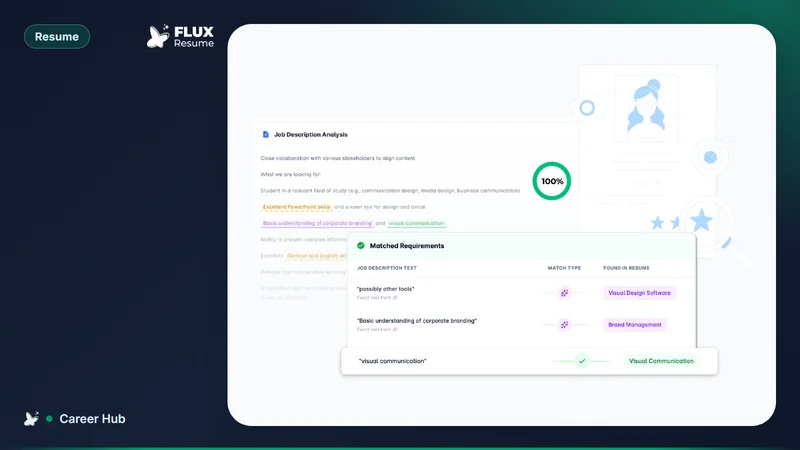
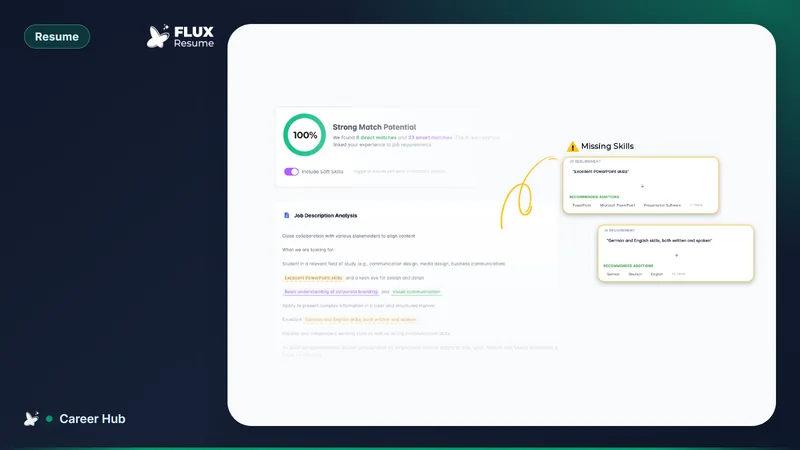
With a job attached, the Job Based Resume analysis shows which of the posting's requirements your text already matches and which are missing, which beats re-reading the listing twice. Whether to tailor at all is a separate question, covered in should you tailor your resume for every job. For more worked examples by role than this post has room for, see fluxresume.io/guides/resume-summary-examples-that-convert/; you can build the section itself at fluxresume.io/resume-builder/.
What makes a summary get skipped
Five patterns, roughly in order of frequency.
It opens with an adjective instead of a title. It contains no number anywhere. It is identical across every application, which a reader can often tell because it matches nothing in their posting. It runs ten lines, at which point it has become a duplicate of the experience section. Or it claims expertise the rest of the resume does not support — strategic leadership above three bullets about ticket queues reads as a mismatch, and the reader believes the bullets.
The skills list has its own version of this problem and a different fix: see how many skills to list on a resume.
Questions people ask about resume summaries
How long should a resume summary be?
Four to six lines in paragraph form, or four to six bullets — roughly 50 to 90 words. Beyond that you are competing with your own experience section for attention, and the experience section wins because it has dates attached. If it will not fit, the usual cause is that you have written responsibilities rather than outcomes.
Do I need one at all?
Above entry level, yes — it is the only section where you get to frame the rest of the document. Skip it on a genuinely one-page resume with a single role, where the summary would restate the bullets underneath it. Never replace it with an objective statement to fill the space.
What if I have no numbers to quote?
Use scope instead of results: accounts supported, systems maintained, people trained, volume handled, regions covered. "Handled 60 support tickets a week across three products" is concrete and verifiable, which is what the number was for. Then start recording numbers now, so the next version of this section writes itself.
Should a career changer write it differently?
Yes. Lead with the target title, name the transition in one explicit clause, then use achievements that transfer rather than the ones that were most impressive in the old field. A hiring manager reading an unexpected background wants to know in the first line that the application is deliberate; leaving them to infer it is how a career-change resume gets set aside. The rest of the document needs the same treatment — see how to write a resume when you are changing careers.
Is a summary different on a CV?
On a UK or European CV — the same short, targeted document Americans call a resume — it works identically. On an academic CV it usually does not appear at all, because that document is a cumulative record rather than a pitch. CV or resume: which one does the posting want covers which you are writing.
Originally published April 2025. Reviewed and rewritten for FluxResume in August 2026.