Should you tailor your resume for every job?
For most applications yes, but only three sections change: the summary, three to five bullets, and the skills list. Titles, dates and numbers never move.

For most applications, yes — but only three sections change: the summary, three to five experience bullets, and the skills list. Titles, employers, dates and numbers stay fixed. Referrals and internal moves are the honest exceptions. Tailoring does not mean adding a skill you do not have, and it will not rescue an application you are not qualified for.
That is the decision. What follows is the reasoning, the cases where the answer flips, and the line between tailoring and lying.
- Three sections carry the tailoring: the summary, three to five experience bullets, and the skills list.
- The factual spine — employers, job titles, dates, team sizes, budgets, percentages — is identical on every copy you send.
- A referral or an internal move is read by a person before any software touches it, so the return on tailoring is lower there.
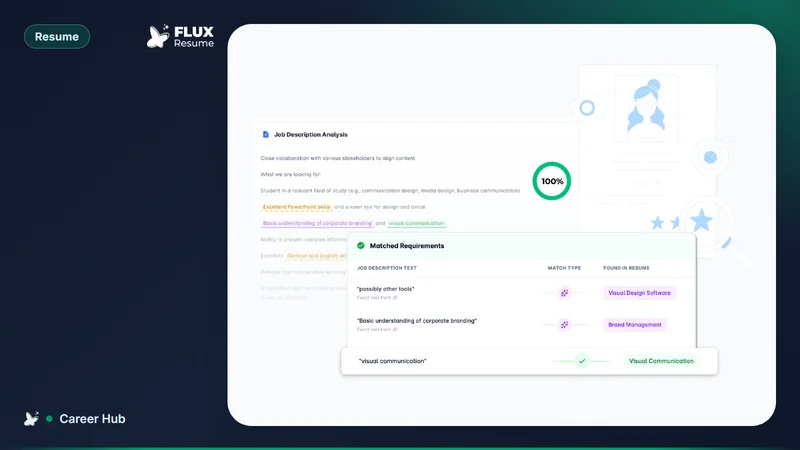
- FluxResume's match score measures one resume against one posting. It is not an ATS score, and no applicant tracking system vendor publishes a forwarding threshold.
- If you could not defend a tailored bullet out loud for two minutes, it is not tailoring.
What changes, and what never does
Three sections do the work.
The summary changes most, because it is the only part of a resume written entirely for one reader. Lead it with the title on the posting and the two or three requirements the posting repeats. Applying for a Site Reliability Engineer role, the summary says Site Reliability Engineer, not "results-driven technology professional." More on that block in what a resume summary should actually say.
Three to five experience bullets get reordered and reworded — not all of them. You are moving the relevant work up the page and using the posting's vocabulary for it: "incident response" instead of "on-call fixes," if that is the phrase they used. The underlying achievement is untouched.
The skills list is swapped, not extended. Pull the eight to twelve terms this posting asks for out of the longer list you keep privately; see how many skills belong on a resume for choosing them and how to add keywords without stuffing for where each term has to sit to carry weight.
Nothing else moves. Employers, dates, titles as they appeared on your payslip, headcounts, revenue figures, percentages. Those are facts, and a resume is a document you get interviewed against line by line. Two versions of your history carrying two different numbers is the fastest way to lose an offer at reference stage.
Where is the line between tailoring and lying?
Tailoring is re-emphasis. Lying is a new claim. The test is whether the sentence was already true before you read the posting.
"Led the migration" becoming "Led the Kubernetes migration" is fine, if it was Kubernetes. "Contributed to the migration" becoming "Led the migration" is not tailoring, and it is the specific failure mode AI rewriting introduces, because a model asked to close a gap will sometimes close it with a sentence you never earned.
FluxResume's Smart Match Resume pass rewrites your professional summary and bullet points against the posting, and it flags what it changed and how far the wording moved. The Job Based Resume walkthrough covers that review screen, and the step-by-step version of the flow is already written, so this post will not repeat it. The decision it leaves you is the one that matters: read every change before you download the PDF, and delete anything you would have to talk your way around.
That is the honest limit. FluxResume reads the posting and your resume. It has no access to your employment record, so nothing in the product can verify a claim you make about yourself, and nothing in it will stop you downloading a resume you cannot defend.
When is tailoring not worth the time?
Four situations, none of them rare enough to ignore.
A referral. Someone is putting your resume in front of a hiring manager with their own name attached, and a human reads it first. The referrer's framing becomes the constraint instead of keyword alignment. Send a clean, relevant resume and spend the saved time writing that person a paragraph they can forward.
An internal move. The hiring manager can look up your last two performance reviews. Pointing the summary at the internal posting is still worth five minutes; rewriting bullets about work your own company already knows about is not.
A role you are applying to out of curiosity. If you would decline the interview, send the closest existing version or do not apply.
A posting with nothing to tailor against. Some listings are four lines of boilerplate and a salary band. There is no vocabulary to mirror, and tailoring against vague copy mostly produces vague copy.
Everything else — the company careers page, the job board apply, the agency submission — is worth the three sections.
What match number should you actually aim for?
Aim for a strong match on FluxResume's own scale, and be clear about what that scale is.
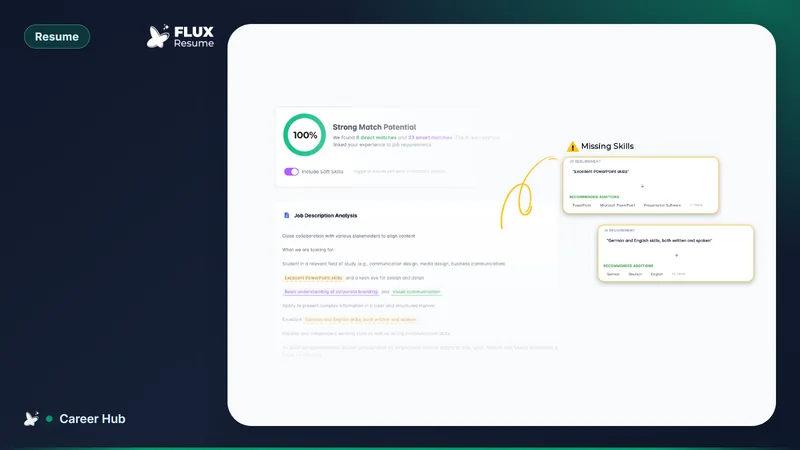
The Job Based Resume analysis scores one resume against one posting, with documented bands: below roughly 50% is a weak match, 50–70% is good, 70% and up is strong, 85% and up is excellent. Those bands are FluxResume's, they describe FluxResume's reading of the posting, and they are numbers you can check on your own screen.
They are not an ATS threshold. A great deal of resume advice states that applicant tracking systems reject anything under a 70% keyword match, or that only top scorers get forwarded to a human. That claim is invented. Match cut-offs, where employers use them at all, are configured per requisition, no vendor publishes them, and nobody outside the hiring company can see what a given posting is set to. If a source gives you the number, the source does not know it. Why an ATS rejects a resume, and what fixes it covers what actually goes wrong, which is usually parsing rather than scoring.
So treat 70%-plus as a working target on a tool you control, not as a gate somebody else is holding. And when the score will not move past 50%, the useful conclusion is usually about the application rather than the resume: you are missing the core of what the role does, and rewording will not add it.
How long should this take, and what makes it slow?
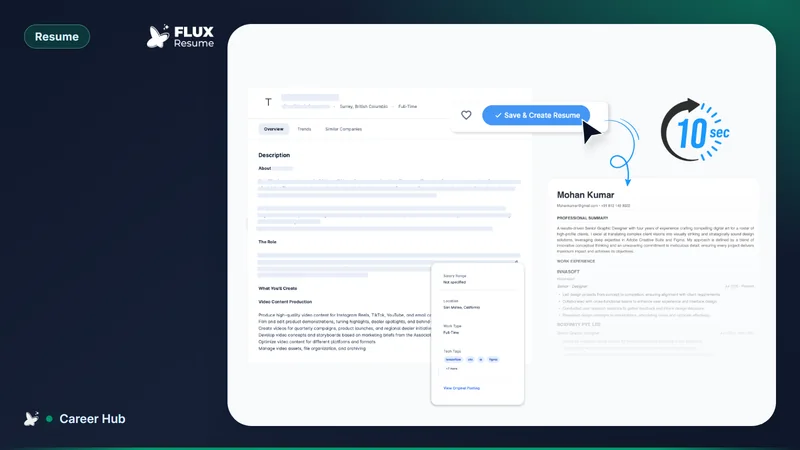
Ten minutes for the three sections, on a posting you have already read.
What gets abandoned is rarely the writing. It is the twenty minutes before the writing, spent re-reading the listing, holding a term list in your head, and scrolling between two documents to work out what is missing. Starting from a resume already attached to the posting removes that: opening a role from Job Search and generating a job-linked resume brings the description, company and requirements into the editor, so the comparison is on screen instead of in your memory. Product pages for that flow are fluxresume.io/job-based-resume/ and fluxresume.io/on-the-fly-resume/.
The other cost is running one resume across four kinds of role. If you are applying to both backend engineering and engineering management, you are tailoring across a gap no single starting document handles well. Resume Profiles exist for that: separate workspaces, each with its own resume list, tracked applications and matching keywords. Two clean starting points beat one document you rewrite from scratch every time.
Questions people ask about tailoring
Is tailoring worth it at twenty applications a week?
Yes, though twenty may be the wrong number. Ten minutes across three sections is roughly three hours a week at that volume, which is sustainable. If it is not, the honest trade is fewer, better-matched applications rather than twenty untailored ones — volume without relevance mostly generates silence, and silence teaches you nothing.
Does letting AI rewrite a bullet count as lying?
No, as long as the claim was already true. A model rewording "cut build times" into "reduced CI pipeline duration by 40%" is fine if the 40% is yours and fabrication if it is not. The obligation the tool cannot take off you is reading each change and cutting the ones that added something.
Do referrals really not need a tailored resume?
They need a relevant one, not a keyword-aligned one. A referral means a person reads the document first and can ask you directly about anything unclear, which is what tailoring compensates for elsewhere. Keep the summary pointed at the role, skip the bullet rewrite, and spend that time on what your referrer will say about you.
What if the posting asks for something I have never done?
Leave it out and apply anyway, if the core of the role is work you have done. Do not add the term to your skills list to lift a score — it will surface in a technical screen and cost you more than the missing keyword would have. A gap you can discuss honestly reads better than a claim you cannot.
Originally published January 2026. Reviewed and rewritten for FluxResume in August 2026.