How do you write a resume when you are changing careers?
The facts stay the same; the summary, the bullet order and the vocabulary change. Which evidence closes a credibility gap, and what to do about the parts that do not transfer.

On a career-change resume the facts stay and the framing changes. Rewrite the summary to name the target title, reorder each role's bullets so the transferable work sits first, and use the target field's vocabulary for work you actually did. Do not claim everything transfers. Do not rewrite a bullet into something you could not defend in an interview.
The instinct is to rebuild the document from scratch, and it is the wrong instinct — it produces either a resume with no verifiable history or one that reads as somebody else's. What changes is which parts of a true record get the reader's attention first.
- Three things change: the summary, the order of bullets inside each role, and the words used for work you already did
- Translation is rewording, not reclassifying; a rewritten bullet describing work you did not do is a fabrication with better vocabulary
- A certification establishes vocabulary and intent, not experience, which is why one shipped project usually outweighs one course
- Reverse-chronological order stays unless your relevant experience is old, in which case a grouped Relevant Experience block above the full timeline carries it, dates intact
- Naming the one thing that does not transfer is what stops a reader assuming nothing does
- Resumes in FluxResume are scoped to a Resume Profile and cannot be shared across profiles, so a pivot resume lives in its own workspace
What actually changes when the target changes?
Not your history. You held the roles you held, for the dates you held them, and every line of that stays. Three things move.
First, the summary gets rebuilt around the target title rather than your last one, in the shape what a resume summary should say sets out.
Second, the order of bullets inside each role. Most roles contain four or five things you did and one of them matters to your target. Put that one first. A support engineer applying to product roles leads with the requirements work and the release coordination and drops ticket volume to third — the same job, in the order the new reader is reading for.
Third, the vocabulary: the same work, named the way the target field names it. This is the change people either skip or overdo. Skipping it leaves the reader to translate for you, and readers do not — a ward coordinator's "staff rota" and an operations team's "capacity planning" can be the same artefact, and only one of them is a phrase the new reader is scanning for. Overdoing it means reaching past the thing you did for the term beside it, which is where a translation quietly becomes a claim. So the change stops at the nouns for the work — artefacts, tools, processes — never touches your job titles, and is not a synonym exercise you can do from memory. The words come from the postings.
What does not change: dates, employers, and the titles you actually held. Inventing a title because it translates better is the same failure as inventing a date, and the same stage of the process finds it.
How do you find out what the target field calls it?
From the postings, in bulk, before you write anything. Read ten job descriptions for the role you want and note the nouns that repeat. Those are the vocabulary — not synonyms you generated, and not what your current field calls the same activity.
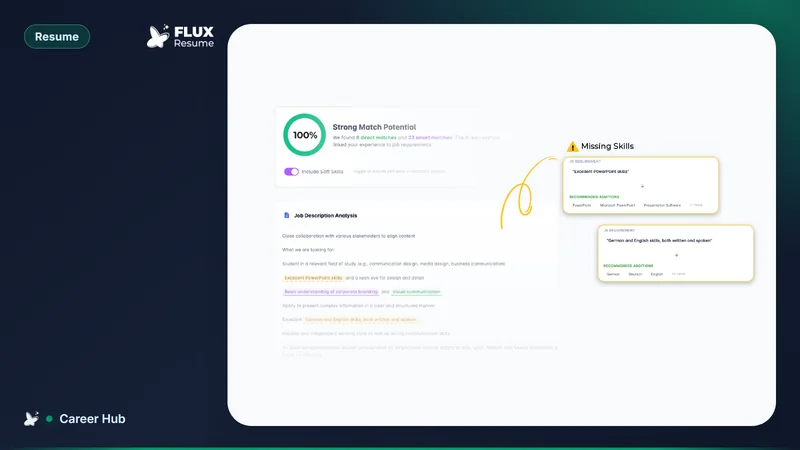
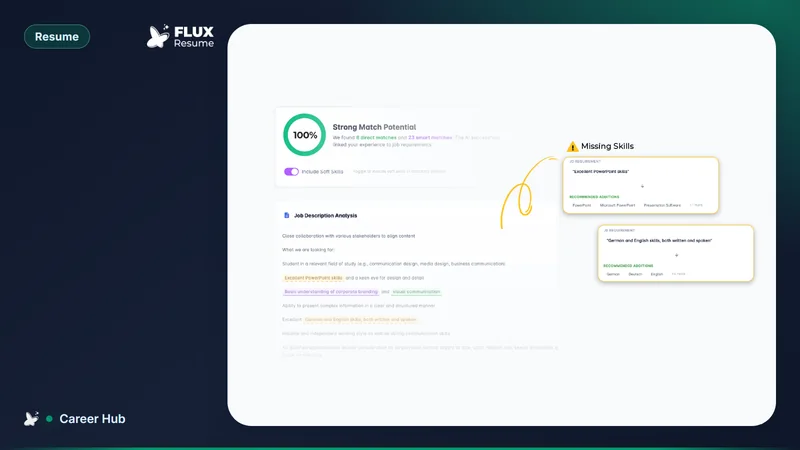
FluxResume does that comparison one posting at a time. A Job Based Resume splits every requirement into Direct Match where your wording already matches, Smart Match where you have the thing under a different name — the documented example is "backend engineering" against "Server-Side Development" — and Missing where the posting asks for something that appears nowhere. On a pivot the Smart Match rows are the interesting ones: each is a piece of your history the matcher recognised despite your phrasing, so each is a bullet worth rewording. The Missing rows split into two piles only you can separate — terms for things you have done and did not name, and terms for things you have not done.
If you are still deciding which target to aim at, Career Navigator runs a ten-question quiz and returns career matches with a match percentage, salary, demand and skills, plus an interactive graph whose nodes are level-up, lateral, management and specialisation moves from a role title you enter. Read it as structured exploration rather than a forecast: the matches come from your quiz answers, and the salary figures attached to them are not a benchmark for any employer. Public page: fluxresume.io/career-navigator/. Where the terms belong once you have them is in adding keywords without stuffing — in the bullet describing the work, not a list at the bottom.
How do you rewrite a bullet without misrepresenting it?
Keep every fact and change the frame. The test is whether the person who managed you would recognise the sentence.
Three illustrative pairs follow; substitute your own work, and use figures only where you have them.
Teacher moving into learning and development. Before: "Taught four sections of Grade 10 biology, wrote all lesson materials." After: "Designed and delivered a year-long curriculum for 120 learners across four cohorts; rebuilt the assessment materials after reviewing results by topic." Same year of work, described as curriculum design because that is what the target field calls it.
Store manager moving into operations analysis. Before: "Ran a store with 18 staff and hit sales targets." After: "Owned weekly forecasting and P&L for an 18-person site; reduced stock write-offs by changing reorder points after reviewing three quarters of sales data." Nothing was added — the scope was already there, buried under "ran a store".
QA engineer moving into product management. Before: "Wrote and executed test plans for a payments platform." After: "Defined acceptance criteria with engineering and support for a payments platform, and prioritised defect fixes against release dates." This is the closest of the three to the line you must not cross, and it stays on the right side because defining acceptance criteria and prioritising fixes are things a QA engineer genuinely does.
The version that crosses it: "Owned the product roadmap for the payments platform." If you did not own the roadmap, that is a claim rather than a translation, and it will be examined, because roadmap ownership is the first thing a product interview asks about. A rewritten bullet you cannot narrate for two minutes under questioning is worse than the original, which at least survives contact.
What evidence closes the credibility gap?
Three kinds of evidence do this, and they carry different weight.
Work you shipped in the target discipline carries most, because it is direct evidence rather than a proxy: a project someone can open, a dataset you cleaned and published, a small tool in use by somebody who is not you.
A paid piece of the new work done inside the old job is the strongest version of that and the most overlooked. An analyst who ran a reporting migration did engineering work under supervision with real consequences, and it belongs on the resume as its own bullet in the new field's vocabulary because it has a manager attached to it. Look for this first; most people changing careers have already done a slice of the target work under a title that hides it.
Then a certification, with its limits stated. It proves you learned the vocabulary and sat an exam. It does not prove you have done the work, and a reader who has interviewed certified candidates without experience knows the difference exactly. Put it in Certifications, do not build the document around it, and pair it with something from the first two categories. Whether to apply at all when the credential is all you have is a different call, made in should you apply when you don't meet every requirement — that post owns the decision, this one owns the document.
How do you order sections when the relevant experience is not recent?
Group it, but keep the timeline.
Default to reverse-chronological, because readers and parsers both expect it. When your most relevant experience is four jobs back, split the experience section: Relevant Experience first, with the two or three roles that speak to the target in full detail, then Additional Experience with the rest listed briefly — title, employer, dates, one line each. Every date stays visible, so nothing is concealed and the reading order matches the reader's priority instead of the calendar's. A Projects section can sit above Work Experience when a project is your strongest evidence, and Education moves up only when it is the credential that qualifies you for the change.
What you should not do is drop the chronology for a functional format, for the reason set out in explaining a gap in your employment history.
If you are running two searches at once, FluxResume keeps them separate: a Resume Profile is an isolated workspace with its own resumes, tracked applications and preferences — the documented example is a QA engineer with one profile for current-role applications and one for product roles. Two constraints: resumes cannot be shared between profiles, and archiving a profile cannot be undone from the interface.
What do you say about the parts that do not transfer?
Name the largest one in a single sentence, in the cover letter or the interview, and follow it with what you have instead.
This is the part people skip, and skipping it is what gets the resume discarded. A career-change resume where all twenty bullets have been translated into the target field's language reads as uniformly plausible, which reads as unverifiable — the reader cannot tell which parts are real, so the safe assumption is that none of them are load-bearing. Leaving three bullets in their original, obviously-not-relevant form establishes that the translated ones were translated for a reason.
The sentence itself is short. "I have not managed engineers, so I would come in as an individual contributor" is complete, and it makes everything around it more believable. What fails is a paragraph of pre-emptive reassurance in the summary, and what fails harder is claiming the gap does not exist and having the interview find it in fifteen minutes.
Money arrives earlier in a career change than people expect, because the level is often ambiguous, so answering the salary expectations question matters more than usual — your previous number is a poor anchor for either side.
Common questions about career-change resumes
Do I need a functional resume for a career change?
No, with one exception, and it is not one you choose: when an employer's own form asks you to group your experience by skill or competency — some internal-transfer and public-sector applications are built that way — you answer in the structure they gave you. Picking the format yourself on an ordinary application is the mistake, and explaining a gap in your employment history sets out why. Everywhere else: reverse-chronological, Relevant and Additional splitting the experience section if your best evidence is old, dates visible on every entry.
Should I remove the jobs that are not relevant?
Not the roles — the detail. Deleting employers creates unexplained gaps, and a gap costs more than an irrelevant job. Keep every role with its dates and cut the unrelated ones to title, employer, dates and one line. Keep any bullet from those roles that speaks to the target: a warehouse job with a scheduling-system rebuild in it is relevant to operations work.
Will AI optimisation write the career-change version for me?
Partly, and the risky part is the part you check. Smart Match Resume on a Job Based Resume rewrites the summary and bullets toward the posting and shows each change as a before/after pair with a risk badge, plus a New content badge on bullets it added. On a pivot, the medium-risk edits and the new-content bullets are where over-claiming happens. Read each one and delete anything you could not narrate under questioning.
On this page
- What actually changes when the target changes?
- How do you find out what the target field calls it?
- How do you rewrite a bullet without misrepresenting it?
- What evidence closes the credibility gap?
- How do you order sections when the relevant experience is not recent?
- What do you say about the parts that do not transfer?
- Common questions about career-change resumes