How do you explain a gap in your employment history?
One factual sentence, no apology, in the place the reader is already looking. Which gaps earn a labelled line, and why the functional resume draws attention instead of deflecting it.

Explain an employment gap in one factual sentence, past tense, without apology: what you were doing and that it ended. Put it where the reader is looking: the resume dates, or one line in the cover letter. Answer it once in the interview. Never change dates to close a gap. Never invent a consulting business you did not run.
Most people over-prepare this. A gap is a missing piece of information in a document made of dates, and the reader's question is small: what was that time, and is it over. One sentence answers it. Three paragraphs tell them you think it is disqualifying, and then they believe you.
- Explain the gap once, in one place — resume line, cover letter sentence or interview answer, not all three at increasing length
- Years-only dating is legitimate when every role uses it, and reads as evasive the moment one role carries a month and the rest do not
- A labelled line helps when the reason has a name a stranger accepts, and hurts when it is vague enough to invite a follow-up question
- Nobody outside a hiring team can tell you what a gap costs you; the percentages quoted for it are not attributed to anything you can open and read
- Misstated dates surface at the reference or verification stage, where what has been found is dishonesty rather than a gap
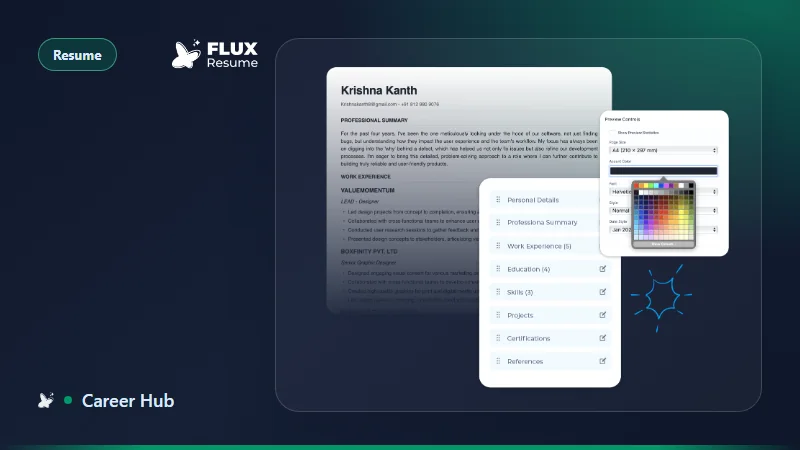
- FluxResume's documented resume sections — Details, Summary, Work Experience, Education, Skills, Projects, Certifications, Volunteering and more — include no career-break field, so you label that entry yourself
Is a gap a problem, or just a question?
A question. It becomes a problem when one of two conditions holds: the reader cannot work out what the time was, or the gap is still running and you have nothing current to point at. Neither has much to do with length.
You will find confident figures for how often gaps get resumes discarded. Ignore them — screening happens inside individual companies, by people making unrecorded judgements against unpublished shortlists, so there is no population to measure and nobody positioned to measure it. The mechanism is what you can act on: a reader with forty applications open resolves ambiguities fast, and an unexplained range of dates is an ambiguity.
How do you present it on the resume?
Pick one date format and apply it to every role, including the current one.
Month and year on everything — March 2022 – August 2024 — is the default and the most predictable for a parser. Years-only dating is a legitimate alternative rather than a trick, and it absorbs short gaps because the reader has no month to subtract from. Two conditions make it look evasive. The first is inconsistency: one role dated June 2025 – Present beside three dated by year tells the reader precisely which interval you did not want examined. The second is scale — someone who cannot tell whether the space between 2022 and 2023 is one month or twenty-three assumes the larger figure, so years-only stops helping once the hidden interval passes about a year. Mixed formats also break parsing, one of the failures in why an ATS rejects your resume.
Add a labelled line when two things are true: the break ran long enough that the dates cannot absorb it, roughly six months and up, and the reason has a name you can write in three words. If either fails, leave it off — a period you can only call "personal circumstances" reads as a placeholder, which is the attention you were trying to avoid. When it earns a line, write it like any other entry:
Career Break — Family Caregiving · 2024 – 2025 Full-time caregiving for a family member. Maintained AWS certification and completed two Django projects during this period.
Specific label, closed tense, and a second line that gives the reader something to ask about other than the gap. What breaks it: apology language, a paragraph of context, or dressing the period up as a job title — "Independent Strategy Consultant" for a period with no clients fails at the first question about clients. Keep it out of the summary as well; that block names the target title and what you have delivered, as what a resume summary should say sets out.
What do you say when they ask?
Answer in two sentences and then hand the conversation back. Say what it was, that it has ended, and the one thing you did during it that is relevant here. "I took eighteen months out to care for a parent. That finished in March, I kept my certification current, and I have been building back-end projects since — which is why this role interested me."
The version that fails is the over-explained one. Length reads as defensiveness, so a four-minute answer makes the interviewer wonder what the shorter version concealed, and every extra clause is a new thread to pull. The related failure is answering it well and then continuing to answer after the interviewer has moved on.
Expect the follow-up to be an ordinary competency question rather than more digging into the dates, which is why the preparation that matters here is the normal kind — the patterns in behavioural interview questions are what the rest of the conversation is made of.
One sentence in the cover letter is the other allowance, positioned late rather than in the opening. There is a prompt scaffold for it in using ChatGPT to write your cover letter, with the caveat that post makes: a model filling a gap in the brief invents a plausible employer or reason, and the invention reads perfectly. To rehearse the spoken version, AI Chat has an Interview Prep shortcut among its quick suggestions — how to prepare for a job interview covers what the chat is working from. It knows only what you type into it, so the useful output is a shorter draft of your own answer, not a script.
Which gaps need different handling?
The reason changes what you owe the reader, and that matters more than any template.
Caregiving is the cleanest case: common, finite, understood. Name it, date it, close it.
Health is where you owe the least. "A health matter, now resolved" is a complete answer, and no hiring process is entitled to a diagnosis.
Redundancy followed by a long search is the hard one, because after the first few months there is no external event left to point at. The redundancy explains the start of the gap; it does not explain month nine. What fills that space is whatever you actually did — contract work, a certification, an open-source contribution — so the answer to a long search is built during it rather than composed afterwards.
Study and a planned sabbatical get spoiled by vagueness. A named programme with dates, or "a planned six-month break after eleven years, ended in January", is enough. Do not sell a sabbatical as strategic development; it was time off, and saying so is more credible.
A business that did not work out is a real role and belongs on the resume with its dates, scope and outcome — founder, two years, what you built, why it closed. The failure here is retrospective relabelling: turning a closed company into a "consulting practice" that quietly continued for another year.
What if the gap is running right now?
Then the answer moves into the present tense and needs one dated, checkable thing in it.
Small is fine; vague is not. A named course with a completion date, a client with a real invoice behind it, a volunteering commitment at a named organisation, a project someone can open — any one of those turns "unemployed since April" into "since April, doing this". What you cannot do is backfill the earlier months. The resume shows your last role ending when it ended, plus what is true now.
If you are changing direction rather than returning to the same work, the document problem is different and the emphasis moves; that is what writing a resume for a career change is about. Either way, tailor from one master rather than keeping a folder of near-identical files. Documents is the hub for resumes, and for cover letters and SOPs when those features are on for your plan; in the resume editor, the Summary section has an AI assistant with Generate, Rewrite and Customize modes — one documented constraint being that the download is a PDF. You can start one at fluxresume.io/resume-builder/.
What does not work
Three approaches fail here, and the first two are worse than the gap itself.
Inflating dates or overlapping roles to close the space is the first. Stretching an end date by four months feels like rounding. It is the one recoverable-looking mistake that is not recoverable: dates get confirmed at the reference or verification stage of many hiring processes, and what surfaces then is not an unexplained gap but a document you knowingly falsified. Offers are withdrawn for the second thing, and the gap was survivable.
The second, inventing a consulting entity you did not run, collapses on contact, because consulting has artefacts — clients, invoices, a deliverable, someone willing to be a reference. The first question is who you worked with, and there is no good version of the next thirty seconds. Freelance work you genuinely did is a different matter; put it on with the clients named.
The third is the functional or skills-based resume, sold as a gap-hider. It groups experience under skill headings and demotes the chronology, which removes the one thing the reader came to check. They hunt for the dates, find them missing, and the missing chronology becomes the question instead of the gap — a format that announces the problem it was chosen to conceal. Stay reverse-chronological and answer in a line.
Common questions about employment gaps
How long can a gap go unexplained?
Anything the dates absorb — under about six months on a years-only resume, under about three when you date by month. Beyond that, unexplained means the reader fills the space themselves, and their guess is usually worse than your reason. Length is not the deciding factor; whether the reader has to guess is, and one line removes the guessing.
Do I explain it in the cover letter or wait for the interview?
If you are writing a letter, one sentence in it, late — the mistakes that get a cover letter skipped has the phrasing. What that post does not cover is the now-common case of an application with no letter field at all. Then the dates carry it alone: keep them consistent, and label the break where it earns a line. If there is a free-text "anything else we should know" box, one factual sentence goes there; if there is nothing, bring the spoken version to the call.
Does a gap matter less if I am changing careers?
It changes shape rather than shrinking. A break that lines up with a deliberate change — study, a certification, a first project in the new field — is easier to explain than an unaccounted one, because the gap and the pivot are the same story. The resume work is separate: the summary and bullet emphasis still have to be rebuilt for the new target.