How do you prepare for a job interview?
Reread the posting and the company's own pages, build six to eight stories from your own work, reread the resume you actually submitted, and confirm the logistics the day before.

Reread the posting and the company's own pages, build six to eight interview stories from your own work, and reread the exact resume you submitted for that job. Confirm the logistics the day before. Memorising scripted answers does not survive a follow-up question, and asking an AI assistant to research the company returns confident detail that may be false.
- Read the posting and the company's own pages rather than a summary of either; a summary drops the requirement wording the interview will use
- Six to eight stories from your own work cover more ground than sixty memorised answers, because one story answers several questions
- Reread the exact file you submitted — if you tailor per application, the resume in front of the interviewer is not your master copy
- Confirm the joining link, the entrance, who to ask for and the stated length the day before, not on the day
- Preparation cannot fix a missing must-have credential, and it cannot make a recited answer survive one follow-up question
- FluxResume's AI Chat carries quick-suggestion chips including Interview Prep and Research Company; nothing in the product schedules an interview, reminds you of one, or writes the date into a calendar for you
What do you do in the last three days?
Open the posting again — not your notes on it, and not the version an aggregator paraphrased, because the employer's own requirement wording is what the questions get built from. Read it twice: once to separate the genuine must-haves from the wish list, and once to write down which of your own experiences answers each must-have. Whether the list is worth taking at face value at all is answered in should you apply when you don't meet every requirement.
Then read the company's own pages. Their product or pricing pages tell you what they sell and to whom, which is more useful in a room than their mission statement. Their newsroom or engineering blog tells you what they shipped recently. Their careers page tells you how they describe themselves to candidates, and the last thing you want is to ask a question it already answers. If they are publicly traded, the last earnings call transcript is management explaining their own priorities under pressure.
Last, read the interviewers. A name and a title in the invite is enough to tell whether you are talking to the person who will manage you, someone who will work beside you, or someone screening for process — which changes what you ask at the end.
The order of those days matters more than the hours you put in. Three days out is for reading, because what the posting and their own pages say changes what you say everywhere else. Two days out is for your own material — the stories, and the resume you actually submitted — both of which get shorter and more specific once you know which requirements the role turns on. Leave the day before for logistics and nothing else: a joining link that needs an account you do not have is a problem with a fix at six in the evening and no fix at nine the next morning.
Leave the morning itself empty. Rereading everything an hour beforehand adds nothing you did not already have the previous evening, and it arrives in the room as the tightness an interviewer hears in your first answer.
Why does a story bank beat memorised answers?
Because the list of questions is longer than any list you could memorise and the underlying material is not: six to eight stories from your own work, not sixty answers, since one story about a project that went badly covers failure, pressure, what you would do differently and the stakeholder who disagreed with you. Choosing them and shaping each one so the interviewer hears the outcome is the whole subject of how to answer behavioural interview questions.
Have you reread the resume you actually submitted?
This is the step people skip, and it produces the worst thirty seconds of an interview: being asked about a bullet point you do not recognise. If you tailor per application, the document in front of the interviewer is not the one you have been editing since. It is a copy, frozen at submission, with wording you chose for that posting three weeks ago.
Find it and read it line by line. Every number needs a method you can describe, and every tool listed needs an honest answer to "how much have you actually used this?" In FluxResume, job-linked resumes sit on the card grid in Documents with the company, role and match score on the card, and the same file is attached under the Resumes tab of the job in Pipeline, so "which one did I send here" is answerable rather than a guess.
If the file went through AI optimisation, this reread is not optional. On a Job Based Resume, the Optimized Match Assessment tab lists every change as a before/after pair with a risk badge, and the medium-risk ones are where wording was added or rephrased into a claim. Each card has a View AI Reasoning & Interview Prep expander showing the kind of follow-up question the change invites. If a line overstates what you did, edit the line. The tailoring trade-off itself is covered in should you customise your resume for every job.
Which logistics actually cost people offers?
The dull ones do, because they are the only failures that happen before you have said anything.
Remote. Join the actual platform once, from the actual machine, the day before — not a different video tool you assume behaves the same. Camera at eye level rather than pointing up at the ceiling, light in front of you rather than behind, audio tested on the headset you plan to use, notification sounds off, and a check of what is visible behind you. Keep the recruiter's number somewhere you can reach without the laptop: the failure you cannot prevent is your own connection dropping, and the recovery is a text message inside two minutes.
Onsite. Know the building, the entrance and the floor, and know who to ask for at reception by name. Be in the area fifteen minutes early and through the door about five minutes early; earlier than that puts someone in the position of entertaining you. Bring printed copies of the resume you submitted, something to write on, and photo ID if there is a security desk.
Both. Confirm the stated length and format. A forty-five minute screen and a three-hour loop need a different number of stories, and "how many people will I be speaking to" is a reasonable email to the recruiter.
What can preparation not fix?
Four things sit outside its reach, and knowing which they are saves you from over-preparing the wrong part.
Preparation cannot make a script sound unrehearsed. Past a certain amount of rehearsal, answers arrive in a cadence that does not match ordinary speech, and the interviewer notices the delivery instead of the content. Practise the material, not the sentences.
It cannot substitute for a missing hard requirement either. A licence, a clearance or a language the role runs in is not an interview problem. No amount of preparation changes it, and finding out at the final round that one was mandatory is a targeting failure rather than a performance one.
It cannot make an AI assistant's company research true. Ask a general model to "research this company and tell me what to know" and you get fluent, specific-sounding detail about strategy and recent initiatives, some of which may belong to a different company or to nothing at all. Quoting a launch they never announced is worse than quoting nothing. Use a model to organise what you read; read the pages yourself.
And it cannot fix a problem happening earlier. If you rarely prepare because interviews are rare, the work is upstream of this post, and that diagnosis lives in why you aren't getting interview callbacks.
Where does FluxResume fit in interview preparation?
FluxResume holds the context, not the calendar. In AI Chat a new chat starts from either Resumes with Jobs or Resume Documents and stays tied to that resume and job, which is the point: a prep conversation grounded in the posting and the resume you submitted is a different thing from a chat window that has no idea what you applied for. The quick-suggestion chips include Interview Prep, Research Company and Compare with Job, each sending a fixed built-in prompt immediately. Verify anything factual about the company against their own pages before you repeat it.
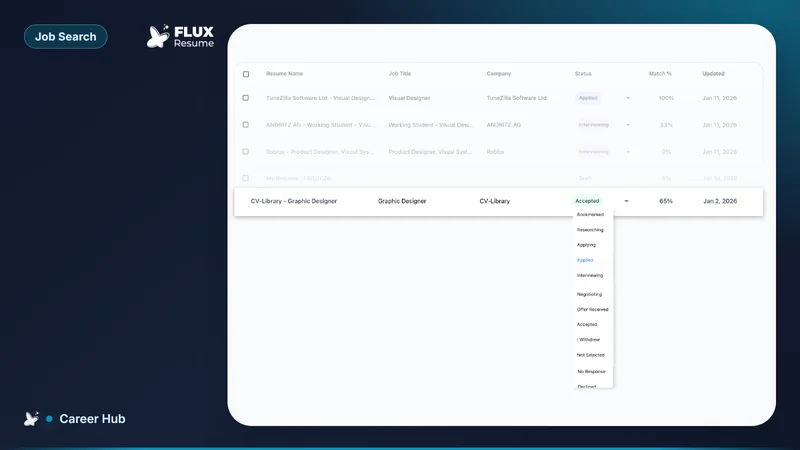
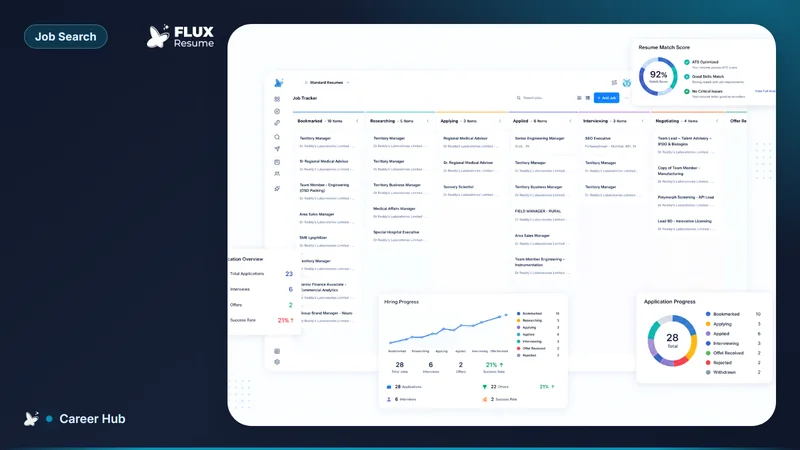
The prep record is the job itself. A job in Pipeline has Notes, Checklist and Contacts tabs, and jobs move through Bookmarked, Researching, Applying, Applied and Interviewing on the board, with Offer Stage and Close Job on the job detail status bar. The Dashboard has an Upcoming Interviews card showing company, role and date with a Prep link into the tracker.
What it will not do: schedule an interview, send a reminder, notify you that tomorrow is the day, or write an interview or follow-up date into a calendar for you. Google Calendar appears in Account Settings as a service you can connect for AI Chat, which is a different thing from the product putting the date in your week. The documentation describes a card you look at and a follow-up date you set yourself, so if your prep depends on being reminded, the reminder comes from your own calendar. Public entry point: https://fluxresume.io/career-prep/. What happens in the twenty-four hours afterwards is a separate discipline, covered in how to follow up after an interview.
Common questions
How many hours should you spend preparing?
For a first-round screen, two to three focused hours: the posting, the company's own pages, your submitted resume, and a pass over your stories. For a final round, more, spent differently — on the specific people, the business problem you would own, and what you want answered before you would accept. Beyond about four hours on one interview you are usually rehearsing sentences, which makes delivery worse rather than better.
Should you write your answers out in full?
Write the stories out once, in facts, then stop. Writing is how you notice that a story has no clear result; reading it back twenty times turns it into a recitation. Rehearse exact wording only where you have to — when you are interviewing in a second language, or when the role needs a precise technical explanation you rarely say out loud.
What should you bring to an in-person interview?
Printed copies of the resume you submitted for that posting, a notebook and pen, photo ID for the security desk, and the names of everyone you are scheduled to meet. Bring a portfolio or work sample only if the recruiter asked. Leave out anything you would have to explain: no folder of certificates, no unrequested references sheet.
How do you prepare for a panel or a same-day loop?
Ask the recruiter for the schedule and each interviewer's role in advance; that request is normal, it gets answered, and it tells you which conversation is the one that decides. Write the names down as you go, because by the fourth conversation you will not reliably remember who was who, and you need them afterwards. Then plan for the length of it: a loop is several hours of sustained attention, so eat beforehand, take the water when it is offered, and give the last interviewer the same energy as the first, since they have no idea how the previous three went.