What do you send after an interview, and when?
A thank-you note the same day, to each person separately, referencing something specific from the conversation. Then one message once the date they gave you passes.

Send a thank-you note the same day, to each interviewer separately, quoting something specific from that conversation. Then one follow-up after the date they gave you passes, and one more only if you fumbled a question and can now answer it. Repeated check-ins do not move a decision, and silence is not a rejection you can act on.
Two messages is the normal total, three if one of them carries an answer you owed them. Everything past that is a message about you, sent to someone managing a hiring process alongside their actual job.
- Same day, one note per person, each referencing something that only came up in your conversation with that person
- If you did not collect addresses, ask the recruiter or coordinator for them rather than guessing at an email format
- When the date they gave you passes, wait a day or two, then send one message that names the date
- The message answering a question you fumbled is the only follow-up carrying new information, and it goes out within a day
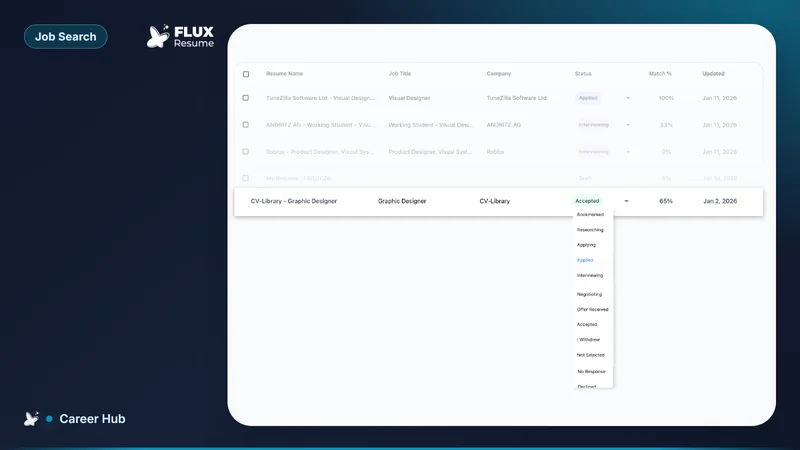
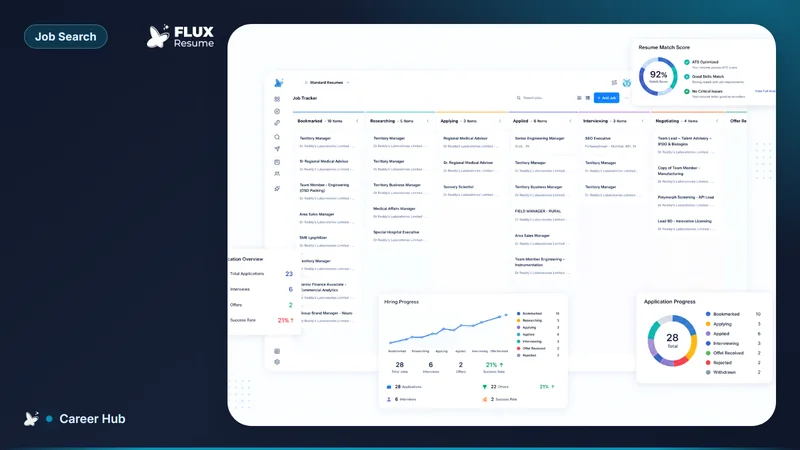
- FluxResume does not remind you: on a job you set a follow-up date from list view or the job detail timeline, on a person you set one and due contacts surface in the Follow Up column of Contacts, and you still have to open the page
What goes in the thank-you note, and when do you send it?
The same day, by email, while you still have the detail. It runs four or five sentences: thanks, one specific thing from the conversation, one sentence on why what you heard makes the role a better fit than it looked from the posting, and an offer to send anything they still need.
The specific thing is the whole point, and there is a test for it. If the sentence could have been written before the interview happened, it is doing nothing. "Thank you for your time, I'm very excited about the opportunity" passes no test. "The way you described splitting the on-call rota after the platform team doubled is the part I keep thinking about — that is the problem I spent last year on" could only have been written afterwards.
Send a separate note to each person you met, not one round-robin message with three names in the To field. Interviewers compare notes, and three people reading identical paragraphs learn one thing: that you wrote it as a batch. Separate notes also let you write about different things, which is easier than it sounds, because each person asked you about their own area. The questions you asked are the richest source of material here — one of the practical reasons the questions you ask the interviewer matter beyond the interview, and the preparation behind them is covered in how to prepare for a job interview.
How do you follow up with a panel when you only have one address?
Ask the recruiter or the coordinator. "Could you share the email addresses of the three people I met this morning, so I can thank them directly?" is a normal request and it is usually answered. If it is not, send one note to the recruiter and ask them to pass on your thanks, naming each person and the thing you would have said to each.
What does not work is inferring an address from a pattern. Guessing [email protected] because that is the shape of the recruiter's address produces one of three outcomes: it arrives, it bounces, or it reaches a different person with the same first name at a company of four thousand people. Only the first is any good, and a bounce absorbed by a catch-all never comes back to tell you.
Collect names during the interview instead, while people are introducing themselves — first name, last name, and what they said they do. Full names are the hard part to reconstruct afterwards and the part you need to find the right person at all. Where those names then live is the dull half of the job: the job detail in Pipeline has a Contacts tab that links a person to the role, the person's own record sits in Contacts, and "who did I actually meet" survives four weeks of silence. Public page: https://fluxresume.io/contacts/.
What do you send when the date they gave you passes?
One message, a day or two after the date, that names the date. "You mentioned you expected to have a decision by the 14th — I wanted to check whether the timeline has shifted, and whether there is anything else useful from my side." That is the whole message. It does not restate your qualifications, it does not re-argue the interview, and it asks one question the recipient can answer in a line.
Naming their own date is what stops it reading as chasing. A follow-up with no reference point is an expression of anxiety; one that quotes the timeline they gave you is an administrative question, and those get answered. If they gave you no date, that is a gap you close for free by asking at the end of every interview when they expect to decide.
This is a different question from following up on an application nobody has replied to, which has its own cadence and its own meaning — that one is covered in why you are not getting interview callbacks. After an interview you have a named person, a stated process, and usually a date, so you are following a timeline rather than guessing at one.
Which follow-up is actually worth sending?
The one that answers a question you fumbled. It is the only message in this sequence carrying new information, which is why it is the only one that can change anything.
Send it within a day, while the interview is still the most recent thing they did on this role. Name the question, give the answer in three or four sentences, and stop. No apology beyond a single clause, no relitigating the rest of the interview, and no second attempt at a question you already answered adequately. If it was about compensation and you gave a number you regret or dodged one you should have answered, read how to answer the salary expectations question before you send anything, because a correction there is a negotiation move rather than a thank-you note.
The limit is worth stating, because this tactic gets oversold. It works when the answer existed and you failed to retrieve it under pressure — the project name you blanked on, the metric you knew, the design you can explain properly with ten minutes and a keyboard. It does not work when the honest answer is that you have not done the thing. A follow-up cannot manufacture experience, and an interviewer who noticed the gap will notice the second attempt papering over it.
What does not work
A second message with no new content is not persistence; it is the same message again. It also changes something that was previously neutral — before, there was no decision about you, and now there is an impression.
Moving to LinkedIn after an unanswered email reads as escalation, however politely it is written. LinkedIn is a fine first channel when it is the only address you have, or when the interviewer told you to message them there; what does not work is reaching for it as the retry after email went quiet.
And silence is not a decision you can act on, because from outside you cannot separate a rejection from an internal candidate, a hiring manager on leave, a headcount freeze or a recruiter who left — the argument in full is in why you are not getting interview callbacks. Treat the role as unresolved rather than won or lost, and keep applying at the rate you were before.
Why is the follow-up date after an interview theirs rather than yours?
Because you usually walk out with a date somebody said out loud, which is the one thing an application-stage follow-up never has. The mechanics of recording it are not specific to interviews and are covered in how to track 20+ job applications; what matters here is that the date you write down is a quotation rather than an invention, and quoting it back is what turns your message into an administrative question. Nothing drafts or sends that message for you, and no interview or follow-up date is written to a calendar for you.
When they gave you no date at all, whatever you record is a date you invented, and the follow-up it produces is the weaker version: with nothing to quote, the message has to ask for a timeline rather than refer to one. Either way the record buys you accuracy four weeks later. "Interviewed 11 August with three people, they said the 14th, I followed up on the 16th" is a fact you read off a card rather than reconstruct, and it is the difference between a considered message and a nervous one.
Common questions
Should you send a handwritten note?
Only in addition to the email, and only where post is a normal part of how that industry works — some client-facing and traditional professional-services firms do notice. On its own it is a bad bet, because it arrives after the decision. Send the email the same day regardless, then post the card if you want to. Never let the card be the reason the email waited a day.
What if they never gave you a date?
Wait about a week from the interview, then send one message asking what the next step is and when they expect to take it. That is the question you should have asked in the room, so you are recovering missing information rather than chasing a decision. If it gets no reply, send one more a fortnight later, then treat the role as unresolved and inactive.
Is it worth asking for feedback after a rejection?
Ask once, briefly, and expect silence. The version most likely to get an answer is narrow: one sentence naming the specific thing you want to know, such as whether the gap was the missing platform experience. Broad requests to "share any feedback" go unanswered, because answering properly takes twenty minutes and creates a written record many companies instruct recruiters not to create.
Can following up cost you the job?
A thank-you note and one timeline check, no. What costs you something is the post-interview version of a judgement error: copying people who were not in the room, or going to the hiring manager after the recruiter asked you to route through them. Judgement is one of the things being assessed, and both of those are visible to a panel that talks to each other. How many messages are reasonable before anyone has met you is a different calculation, made in why you are not getting interview callbacks.
On this page
- What goes in the thank-you note, and when do you send it?
- How do you follow up with a panel when you only have one address?
- What do you send when the date they gave you passes?
- Which follow-up is actually worth sending?
- What does not work
- Why is the follow-up date after an interview theirs rather than yours?
- Common questions