What should you ask at the end of an interview?
Ask three or four questions and change them by who is in the room. The hiring manager, a peer, a skip-level and a recruiter can each answer something the others cannot.

Ask three or four questions, and change them by who is in the room: a hiring manager gets the role's history and the first ninety days, a peer gets how the work actually runs, a recruiter gets process and pay. Do not ask what the careers page answers, and never ask whether they have hesitations about you.
- The same three questions asked to four interviewers waste three of them; a recruiter and a hiring manager cannot answer the same things
- "Why is this role open?" and "what would make this hire a mistake?" produce information no posting contains
- Compensation belongs to the recruiter, who owns the band and the level; a hiring manager usually cannot answer it
- Anything answered on the careers page costs you credibility, because it shows what you did not read
- "Do you have any hesitations about my candidacy?" invites an objection into a room where nobody has to resolve it
- FluxResume has no question library and nothing prompts you; a job in Pipeline has Notes and Checklist tabs, and what you write there is what you get back
Who is in the room decides what you ask
This is where a generic list of "ten great questions to ask" falls over. A hiring manager, a peer, a skip-level and a recruiter hold different information, so asking each the same question means three of your four slots buy you nothing.
The hiring manager owns the role, and is the only person who can say why it is open, what the first ninety days need to produce, and how they will judge whether the hire worked. Ask about their own priorities and their standard, because you will be measured against both.
A future peer knows what the job is like and has no incentive to sell it. Ask them about the week: where work comes from, what gets in the way, what shipped late recently and why, what surprised them when they joined. A peer answers honestly what a manager answers carefully.
A skip-level or senior leader answers above their team's altitude — what the function is being asked to do differently this year, where this team sits in that, what changes if the plan does not land. Do not spend that conversation on process detail they no longer touch.
The recruiter owns the process and, in most companies, the money: next steps, timeline, how many stages remain, the band for the level and how the level was set. These are what the hiring manager either cannot answer or should not have to.
A panel is the fifth case: decide in advance which question belongs to whom, which is part of the preparation in how to prepare for a job interview.
Which questions surface something the posting cannot tell you?
The good ones ask about a specific past or future event rather than a general characteristic. "What's the culture like?" gets you an adjective; "what was the last disagreement this team had about priorities, and how did it get resolved?" gets you a story you can judge. The interviewer has to write the conversation up afterwards, often within the hour, and the question they had to think about before answering is the one that ends up in the note. Five questions return something you cannot get anywhere else.
"Why is this role open?" A growth req, a backfill and a role created after a reorganisation are three different jobs. A backfill has a predecessor, which lets you ask what the last person did well and what they found hard.
"What does the first ninety days need to produce?" If nobody can answer, the scope is unsettled and you would be the one settling it. That may be an opportunity or a trap, but you want to know which before you accept.
"How do decisions get made here?" Ask for an instance: who decided the current roadmap, how long it took, who could have overturned it. Nothing else you can ask predicts as well how frustrating the job will be day to day.
"What would make this hire a mistake?" Uncomfortable and unusually productive, because it inverts the frame — the interviewer stops describing the ideal candidate and starts describing the real risk, which gives you the actual requirements rather than the posted ones. If that posted list already looked unreasonable, what to do when job requirements are unrealistic covers how to read it before you reach the room.
"What has changed here in the last six months?" Reorganisations, departures and a new manager are things you would rather learn now.
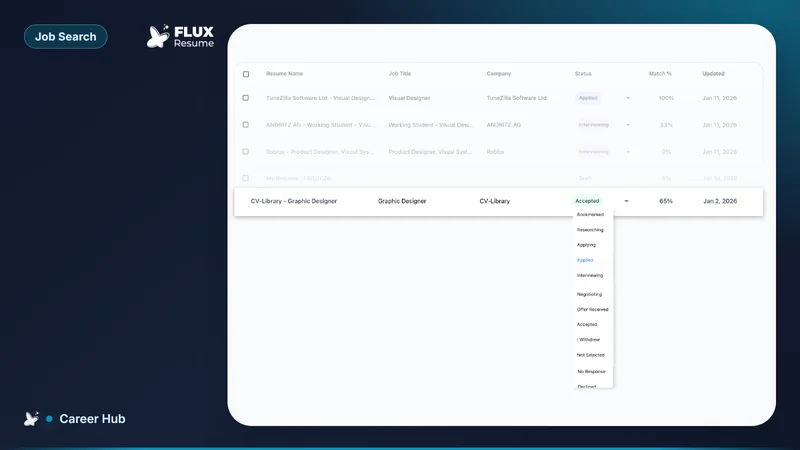
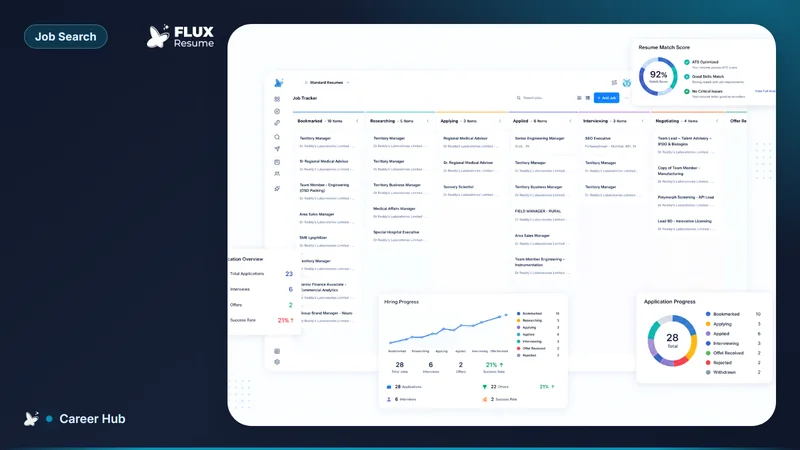
Write the answers down afterwards, because after four interviews at three companies you will not remember which manager said the roadmap was set quarterly. In FluxResume that belongs on the job record, which carries Notes, Checklist and Contacts tabs alongside the resume you submitted on the Job Tracker board.
When should you ask about compensation?
Ask the recruiter, because in most companies the recruiter is the person who holds the band and knows how the level for this role was set. Put the same question to the hiring manager and you have spent one of a small number of slots on someone who may not control the answer and has to go and check it — which is a point about who owns the information, not about pay being an impolite subject. Asking the manager becomes the right move when they raise money themselves, or when you are late in the process and the recruiter has gone quiet on it.
Everything about the number itself — the range you give, how to deflect the question, what to put in the form field that demands a figure — is the other half of this conversation, answered in how to answer the salary expectations question.
What should you not ask?
Skip anything answered on the careers page or in the posting — what the company does, whether the role is remote, how many employees there are. The cost is not that the question is dull; it is the inference drawn about how much of their material you read.
Skip "do you have any hesitations about my candidacy?" as well. It circulates as a confident closing move and backfires structurally: you are asking an interviewer to voice a half-formed doubt on the spot, to a candidate, with no time to resolve it. Most decline politely, and you have spent your closing moment putting the word "hesitation" in the room. The ones who answer name a gap you then have ninety seconds to address badly, and the objection goes into their notes in their words rather than yours. To address a real gap, raise it yourself, earlier, with the answer attached.
Watch for complaints in disguise, too: "how do you stop scope creep here?" is heard as your last job had scope creep.
Anything you would rather have in writing — notice period, start date, policy detail — goes to the recruiter by email. And not "so do I have the job?": what helps at that stage is the follow-up, which has a shape of its own in how to follow up after an interview.
Can a model generate the list for you?
It can generate a draft you then cut, and the cutting is most of the work. A general assistant given a posting produces twenty questions, a large share of which the posting itself answers — it is generating from the posting and has no way to know that quoting it back is the failure mode.
Here is a job posting:

[paste the entire posting]

I am interviewing with the hiring manager, a peer on the team, and a recruiter.

For each of the three, give me five questions that:
- could only be answered by that specific person
- ask about a specific past event or future deliverable, not a
  general characteristic
- are NOT answered anywhere in the posting above

Then list separately any question you generated that the posting already
answers, so I can see what to discard.
That final instruction is the useful part, and you should still expect to delete half of what comes back. A model will also invent context — a reorganisation, a product line, a strategy — and a question built on an invented premise is worse than a dull one, because you then have to defend the premise.
Inside FluxResume, AI Chat runs this from a Research Company chip against a chat that already carries the posting, the mechanics of which are in how to prepare for a job interview.
The limits are worth stating plainly. There is no library of interview questions in the product, nothing stores a prepared list, and nothing verifies that a fact about the company is true — so check anything a model told you against the company's own pages. What survives is whatever you typed into the job's Notes tab, which is also where the answers go afterwards.
Common questions
What if everything you planned to ask was answered?
Ask something anyway. "No, I think you've covered everything" reads as indifference even when it is nerves, and two questions work in almost any room: what they are working on at the moment that they are enjoying, and what they would want this hire to have figured out by month three.
Is it acceptable to read questions from notes?
Yes, and it reads as preparation rather than weakness in every format including video. Have them on paper, glance down, ask. What does not work is reading a list mechanically while the answers go unremarked — the point is the conversation the question starts. Write the answers as you go, which also stops you asking something already covered.
Can you ask about remote work or hours without hurting your chances?
Ask about the working pattern rather than the minimum you can get away with. "How does the team handle overlap across time zones?" and "which days does the team come in?" have factual answers. What lands badly is a question shaped as a limit you are negotiating before an offer exists. If the careers page states the policy, confirm it with the recruiter.