How do you look for a job while you still have one?
Personal device and personal email, references from previous roles, confidentiality asked for in writing, and interviews grouped into few absences.

Your own phone and laptop, and an email address just for the search. Two or three references from previous roles, not current ones. Ask recruiters for confidentiality in writing. Group interviews to limit absences. No privacy setting hides a search from someone who recognises you in a lobby, and slipping performance gets noticed first.
- Personal device, personal network, personal email. A company laptop and a company Wi-Fi network are the employer's to monitor, and usually the employer says so in a policy you signed.
- LinkedIn's settings let you stop sharing profile updates with your network and limit "Open to Work" to recruiters. Neither is a guarantee.
- Two or three references, all from previous roles, each told explicitly that the search is confidential.
- Ask for confidentiality in writing and name the companies that must not be contacted — your employer's clients and partners included, not just your employer.
- With four or five usable hours a week, volume is not available to you. A shorter target list is the only version of this that works.
- FluxResume keeps the record in one account you control, and that is all it does about privacy. It hides nothing from anyone.
What actually keeps a search private?
Separation of hardware and accounts, and a short list of people who know. In that order.
Do the search on your own phone and laptop, on your own network, using an email address created for it — something shaped like firstname.lastname.jobs@ rather than a personal address you have had since school. This is not paranoia about surveillance; company devices and company mail are administered by people whose job is to administer them, and most employment agreements say so in writing. A job board tab open on a work machine during a screen share is a mundane way for this to end badly.
The second half is people, and it is the half that actually leaks. Telling one trusted colleague is the most common way a confidential search stops being confidential, because trust does not transfer — they will tell one trusted colleague too. Keep the count at zero inside your current company, including the person you would otherwise tell first.
Where do the hours come from?
Outside work hours, in fixed slots you defend, and there are fewer of them than you would like. Two evening blocks and one weekend block is a realistic week: roughly four to five hours.
Put research and applications in the evening blocks, because they are interruptible. Put interview preparation in the weekend block, because it is not. Lunch breaks handle short things — replying to a recruiter, setting a follow-up date — and nothing else.
What this changes is targeting, not technique. The daily routine in what an organised job search looks like day to day assumes ninety minutes to two hours a day; you have roughly a third of that, so your version has to be a shorter list of better-matched roles rather than the same list attempted faster. Whether a given posting is worth one of those slots is a judgement call — the wish-list-versus-must-have distinction in unrealistic job requirements is the frame for it.
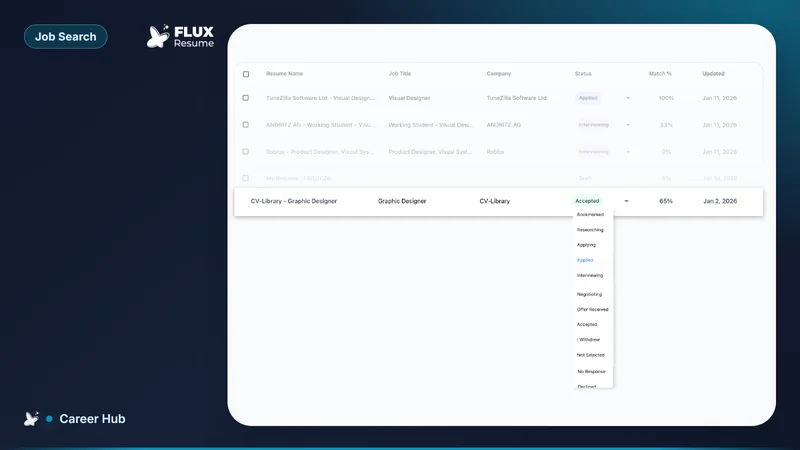
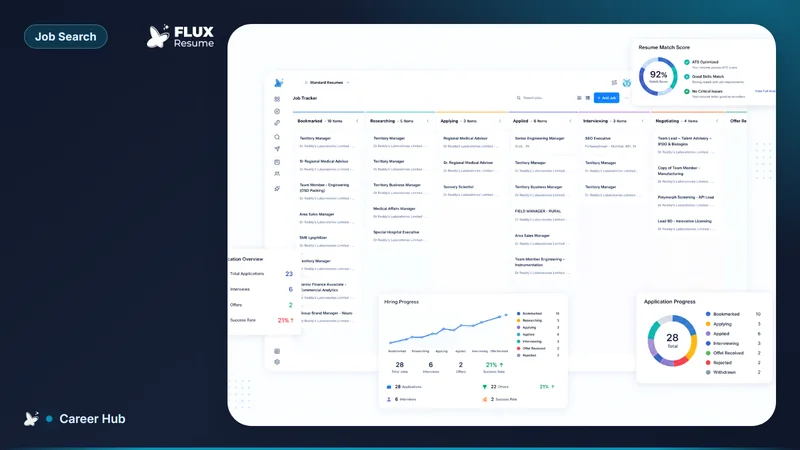
Keep the record in one place, because you will return to it after two-day gaps with no memory of where you stopped. Pipeline holds the stage, the date applied, the resume you sent and the follow-up date on a single card, and the search half sits at https://fluxresume.io/job-search/ rather than spread across your sent folder.
How do you handle recruiters and references?
Ask for confidentiality in writing, in the first substantive exchange, and name who must not be contacted. A line as plain as "I'm exploring options while employed, so please treat this as confidential — do not contact my current employer, and do not submit me to [named companies]" does the work. Include your employer's clients and partners, since a recruiter shopping your resume to a company that shares a board member with yours is a realistic route back to your manager. Get that answer before you send the resume; a recruiter who will not commit in writing is telling you something useful.
References come from previous roles: two or three, ideally one former manager and one peer or direct report. Brief each on confidentiality explicitly, because a well-meaning referee who mentions your name at a conference has undone the whole thing. Hold them back until an offer is genuinely close — a first round does not need them, and every extra person who knows is extra exposure. Keep those people in Contacts with the follow-up dates you set, so the ones you asked a favour of are the ones you thank later. The outreach patterns in what professional networking actually is apply here at a lower volume, not a lower standard.
How do you schedule interviews without a pattern forming?
Prefer video for first rounds, group in-person rounds onto one day, and use leave you are entitled to without explaining it.
Early conversations are usually thirty minutes and can genuinely happen at 8am, over lunch, or after six — ask for those windows directly rather than hoping. When a process reaches on-site stages, ask whether the panel can be consolidated into one visit; most companies accommodate it once you say you are currently employed. Two half-days beats four two-hour absences, and four two-hour absences is what gets noticed.
For the absences you cannot avoid, take leave you have earned. You are not required to give a reason, and "I have a personal appointment" is both true and sufficient. Inventing a specific medical story is a worse trade than it looks: it is a lie you then have to maintain among people who ask kind follow-up questions. Vague and boring holds up; specific and false does not.
Meanwhile keep your performance where it was. This is the least interesting item and the one that matters most, because a drop in output is noticed weeks before a pattern of Tuesday afternoons is. It also protects the two outcomes you cannot rule out: that the search takes longer than you expected, and that you end up needing a reference from the manager you were quietly leaving.
What if someone finds out?
Say that you are exploring options, keep it short, and do not editorialise about the current job. "I've been looking at what's out there. I'm not unhappy here, and nothing is decided" is a complete answer, and it is one you can give calmly because it is true.
What you should not do is treat discovery as a forcing event. People overreact here — resigning without an offer, making demands to prove commitment, writing a long explanation that reads as guilt. In most places the conversation is anticlimactic; managers know employees look, and many are looking too.
Decide two things before you need them: your notice period, and whether you would accept a counteroffer and on what terms. If one arrives, ask whether it fixes the reason you started looking or only the salary — those are frequently different problems, and one returns in six months. Knowing the number you would actually accept is work you do earlier than this, in how to answer the salary expectations question.
The limit worth naming plainly: no tool makes any of this private, FluxResume included. It stores your search in one account instead of six, which is a convenience and not a shield. Open it on a company laptop and the exposure is between you and your employer's IT policy; no feature changes that. Privacy here is four habits — your device, your network, your email, your silence — and software supplies none of them.
Common questions
Can my employer see that I am job searching?
On company hardware and company networks, assume yes, and assume the policy you signed says so. On your own device and network, your employer has no visibility into a job board or a tracker. The realistic exposure is not technical: a colleague who saw a public LinkedIn change, a recruiter who contacted the wrong company, a referee who mentioned it. Manage those three and the technical side looks after itself.
Should I tell my manager?
Usually not, until you have a signed offer. The exception is a manager you have a genuinely open relationship with in a company that handles this well — some do, and internal moves sometimes come out of that conversation. Judge it on evidence, not hope: if you watched how the last person who disclosed was treated, you know the answer. With no evidence, default to not telling them.
Is it safe to turn on "Open to Work"?
Set to recruiters only, it is a reasonable risk. Set to the public photo frame, you are announcing it to your whole network, colleagues included. LinkedIn says it takes steps to hide the signal from recruiters at your own company but does not guarantee it, so someone internal with a recruiter seat may still see it. In a small industry, skip the setting and approach recruiters directly.
Who should I use as references?
Two or three people from previous roles: at least one former manager, plus a peer or direct report who saw your work closely. Tell each that the search is confidential, and give them the resume and job description before the call. Current colleagues are the one category to avoid entirely, however much you trust them, because their accidental disclosure costs you the most.
Originally published January 2025. Reviewed and rewritten for FluxResume in August 2026.